
Sandwich panels are slowly taking over the construction industry, partly due to their exceptional insulating properties. Most people, however, do not know that these panels owe their superior thermal resistance to their core materials, and polyisocyanurate and expanded polystyrene are some of the most coveted core materials.
Despite being covered in similar skins, these insulation materials exhibit different properties, most of which are discussed in this article.
What are PIR Insulation Sandwich Panels

Polyisocyanurate (PIR) sandwich panels are high-performance building sheets comprising an inner layer of polyisocyanurate foam that regulates heat transfer. This internal foam core boasts great thermal resistance and is typically sandwiched by metal facings. In addition to this, PIR sandwich panels demonstrate great resistance against fires, making them perfect for high-risk fire environments such as kitchens.
What are EPS Insulation Sandwich Panels

Expanded polystyrene (EPS) sandwich panels are lighter and closed-cell building materials often utilized in cool rooms and general constructions that prioritize heat regulation. They owe their insulation properties to their inner core, which is basically polystyrene beads. The closed-cell structure confines air, contributing to their relatively lighter weight and excellent insulation.
PIR vs EPS Insulation in Sandwich Panels

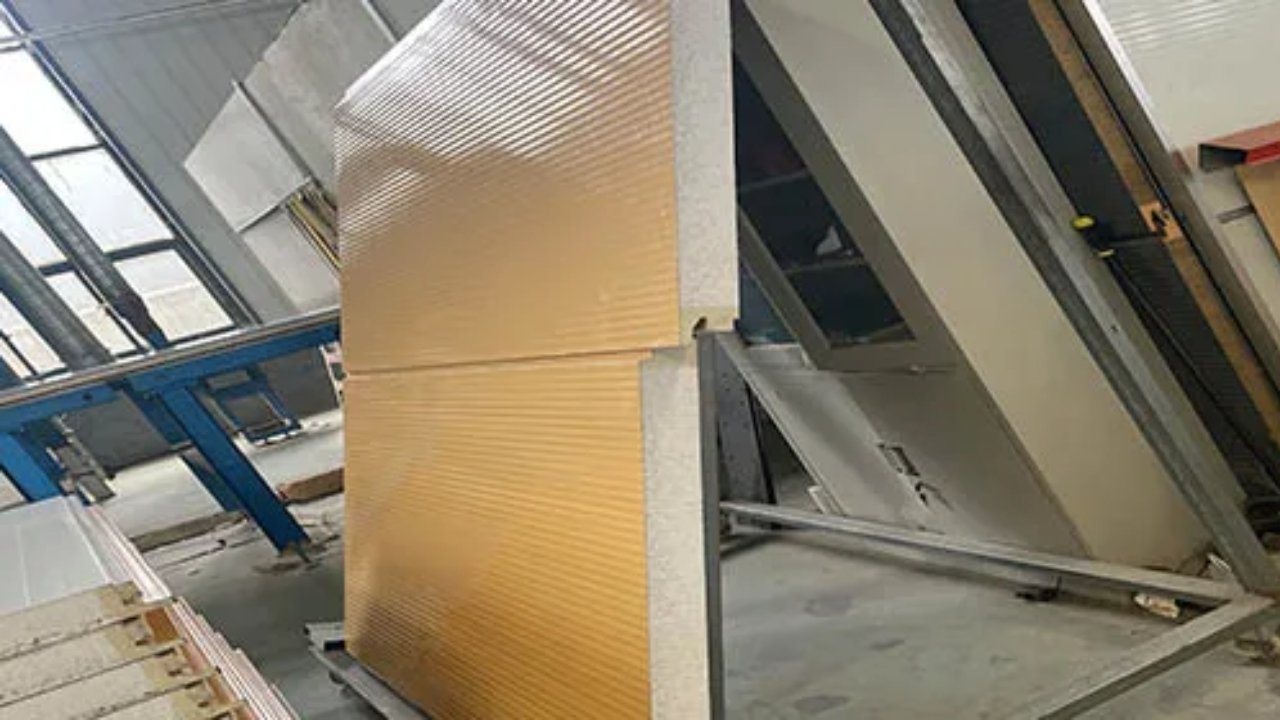
Telling apart sandwich panels with a polyisocyanurate foam core and those with an expanded polystyrene core at a glance is impossible. This is because they both feature similar external facings. However, if you dig deeper, you will find that they behave differently since each core material has distinct properties.
· Core Material
Although both PIR and EPS sandwich insulation panels often have a similar exterior, their core materials differ greatly. PIR sandwich panels have an inner core comprised of polyisocyanurate foam, which is a thermoset plastic that demonstrates immense immunity against flames and fire.
EPS sandwich panels, in contrast, feature an insulation core made of expanded polystyrene beads. These beads carry approximately 98% of air, explaining the comparatively low weight of EPS sandwich panels. Both insulation cores are shielded by steel or aluminum facings.
· Thickness
Polyisocyanurate sandwich panels tend to be comparatively slimmer than EPS sandwich panels. This is because they are more resistant to thermal exchange, meaning less material or space is needed to prevent heat exchange. Expanded polystyrene panels, on the other hand, are slightly better thermal conductors, meaning they require more material to avert heat transfer.
As such, they are relatively thicker than their PIR counterparts. To put this into perspective, bear in mind that the R-value of a 100mm thick PIR sandwich panel is similar to that of a 160mm thick EPS insulation sandwich panel.
· Structure
EPS insulation sandwich panels have a unique structure made up of a multitude of individual polystyrene beads. These beads are subjected to high heat or steam, resulting in their inflation. To be precise, after the expansion, the composition of air in each cell is approximately 98%.
This boosts their thermal resistance, given that the trapped air slows down the loss of heat. This structure also contributes to their characteristic low weight. PIR insulation sandwich panels, conversely, boast an even and finer structure comprising a matrix of cells made from polyisocyanurate foam. This translates into relatively superior thermal insulation.
· Thermal Conductivity
Polyisocyanurate sandwich panels are roughly 68% more efficient at maintaining the prevalent temperatures than EPS panels. This is primarily because they are better at shielding the loss or transfer of heat.
Their average thermal conductivity is 0.022 W/m·K, while that of expanded polystyrene sandwich panels is 0.037 W/m·K. This means that if you construct a wall using PIR panels, you are guaranteed superior insulation.
· Acoustic Insulation
Whilst they are both, at the very least, good thermal insulators, their acoustic insulation is generally questionable. Their compressed structure makes it easier for sound to pass through, making mineral wool sandwich panels better options for applications prioritizing silence. However, PIR sandwich panels tend to block more noise compared to EPS sandwich panels.
· Fire Performance
Polyisocyanurate shows great resistance against fire, especially when reinforced with a fire retardant. This makes PIR sandwich panels more suited to environments or applications with relatively higher fire risks. They boast a fire resistance rating of EI30 and RE30, meaning that they can endure flames or extremely high temperatures for up to 30 minutes before losing their structural integrity.
Expanded polystyrene, in contrast, is likely to lose its structural integrity after 15 minutes of exposure to fire. Their rating is EI15 and RE15, meaning their use in high-risk fire zones is discouraged.
·Moisture Resistance
Owing to the closed-cell configuration portrayed by both Polyisocyanurate and expanded polystyrene, PIR and EPS insulation sandwich panels demonstrate excellent resistance to fluids. They both thrive in outdoor settings where there is continued exposure to moisture and humid conditions. This prolongs their efficiency whilst also averting mold growth.
· Rodent Resistance
Thanks to the strong and hardy penetrable exterior facings in both EPS and PIR sandwich panels, rodents have a hard time accessing their inner cores. However, if they surpass the outer shell, they are more likely to feast on the expanded polystyrene beads. This means that EPS sandwich panels are comparatively less resistant to rodents than PIR sandwich panels.
· Cost
Polyisocyanurate sandwich panels are typically priced higher compared to expanded polystyrene panels. This is because they boast superior properties such as thermal insulation and fire resistance.
However, their return on investment tends to be higher given that they are more energy efficient. EPS panels, conversely, tend to be slightly cheaper initially. In the long run, they attract higher energy bills given that their insulation capabilities are marginally inferior.
Common PIR vs EPS Insulated Sandwich Panel Uses

Although both PIR and EPS sandwich panels are some of the best insulation construction materials, each panel is tailored for specific uses. Examples of their distinct uses are provided in the table below;
| Polyisocyanurate Insulation | Expanded Polystyrene |
| · Cold storage | · Internal walls |
| · Pharmaceutical laboratories | · Portable structures |
| · Clean rooms | · Showroom walls |
| · Kitchens | · Home extensions |
| · Warehouses | · Agricultural sheds |
FAQs
Is PIR insulation in sandwich panels better than EPS insulation?
Yes. Polyisocyanurate, which is the core material in PIR sandwich panels, is more effective in retaining heat or cold compared to extruded polystyrene beads. This explains the recent surge in the use of PIR sandwich panels in the construction industry.
Are PIR sandwich panels fire-resistant?
Yes. PIR sandwich panels are often favored in fire-prone zones like kitchens and laboratories due to their excellent fire resistance. They can hang on to their structural integrity for around 30 minutes while exposed to fire or unusually high temperatures.
What is the R-value of Expanded Polystyrene vs Polyisocyanurate sandwich panels?
An inch of EPS sandwich panels comes with an R-value of 3.6 to 4.2. This is significantly lower compared to the R-value of PIR sandwich panels. The latter’s R-value of 6.0-7.0 demonstrates how good an insulator PIR sandwich panels are.
Are PIR sandwich panels thicker than EPS?
For EPS sandwich panels to match the thermal insulation capacity of PIR sandwich panels, they must be relatively thicker. This is because they are comparatively more conductive. For instance, to replace the insulation of a 100mm thick PIR panel, you would need a 160mm thick EPS panel.
Between PIR and EPS sandwich panels, which are stronger?
Polyisocyanurate sandwich panels boast a density of approximately 35-45 kg/m³, meaning they are more resistant to breaking under force or pressure. Coupling this with their rigid structure makes them stronger than EPS sandwich panels, explaining their extensive use in tougher conditions.
Lutonpanel; Your Trusted Sandwich Panels Manufacturer in China

Lutonpanel has been manufacturing sandwich panels for over 15 years. Our sandwich panels come in different thicknesses with varying core materials. You can choose from EPS, PUR, or mineral wool core materials.
Once you tell us more about your project needs, we will customize every sandwich panel to match your project needs – Request for our product catalogue now.


